"You didn't get less disciplined. Your brain just ran out of a resource that coffee can't replace."
If you're the kind of person who tracks your own output the way other people track their bank balance, you've probably noticed the pattern by now: sharp until lunch, foggy by 2PM, wired but somehow still tired by 6PM. Most founders assume this is just the cost of doing the work. It isn't. Here's what's actually going on — and why the fix isn't another coffee.
Sound Familiar?
- You start the day sharp, but by 2PM you're staring at the same task for 20 minutes
- Your 4th coffee doesn't fix the fog — it just makes your hands shake
- You feel "on edge" more than you feel "focused"
- You've started wondering if this is just what burnout feels like before it gets worse
What's Actually Happening?
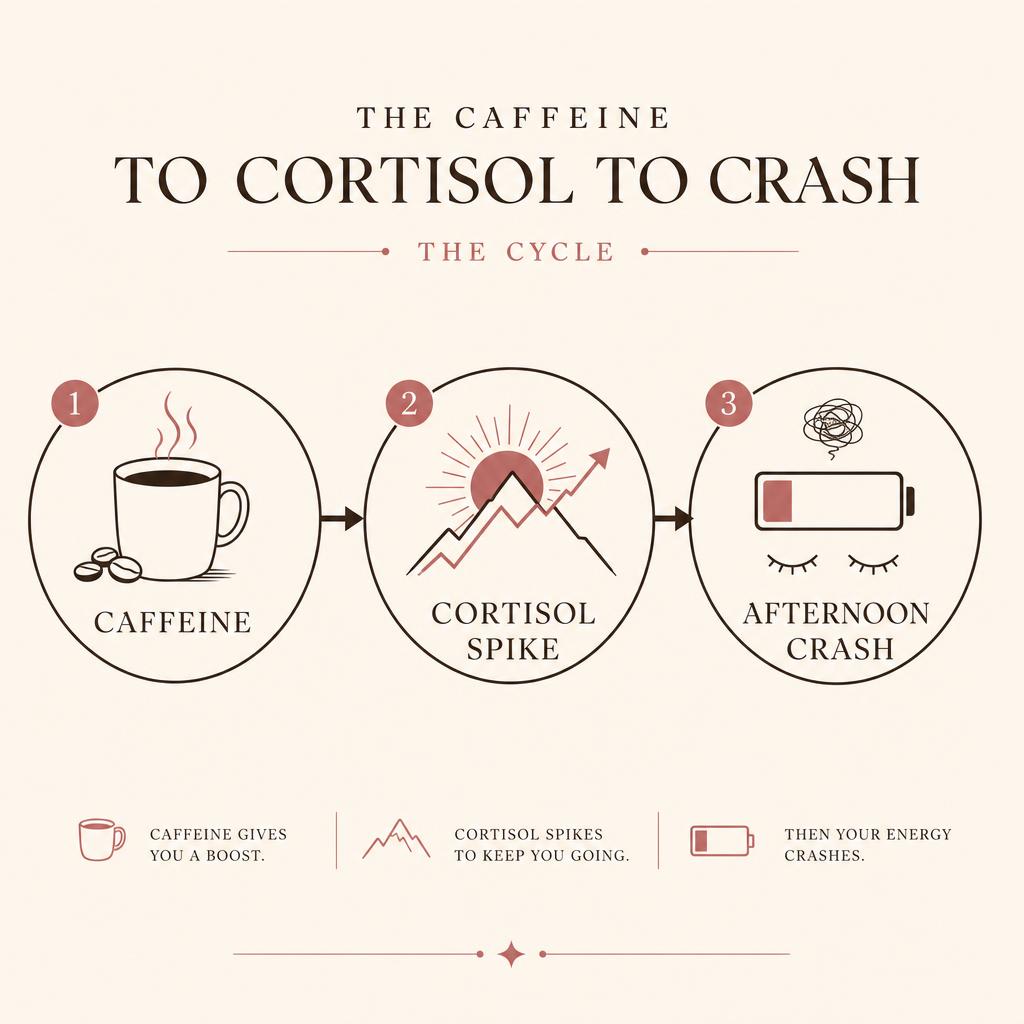
Caffeine doesn't create energy — it blocks the receptors that tell your brain you're tired (adenosine receptor research), while your body keeps producing the same stress hormones underneath. That's why the crash always comes, and why more coffee just means a harder crash later.
What you're calling "focus" for the first two hours of your day is often just adrenaline. It feels productive. It isn't the same as clear thinking.
The Hidden Cost Nobody Mentions
This cycle isn't just uncomfortable — it's a long-term cost. Founders who run on caffeine-driven adrenaline for years are running their nervous system in a constant low-grade fight-or-flight state (chronic cortisol literature). That's the anxiety. That's the wired-but-tired feeling. And it's exactly the pattern that leads to the kind of burnout that takes people out of the game right before the business finally pays off.
Is This Reversible?
The short answer: yes — and you don't have to quit caffeine cold turkey to get there. This pattern is a physiological loop, not a personality trait, which means it responds to the right inputs faster than most people expect. What matters is what you give your brain to run on alongside the coffee, not whether you white-knuckle your way off it.
What Founders Are Doing Instead
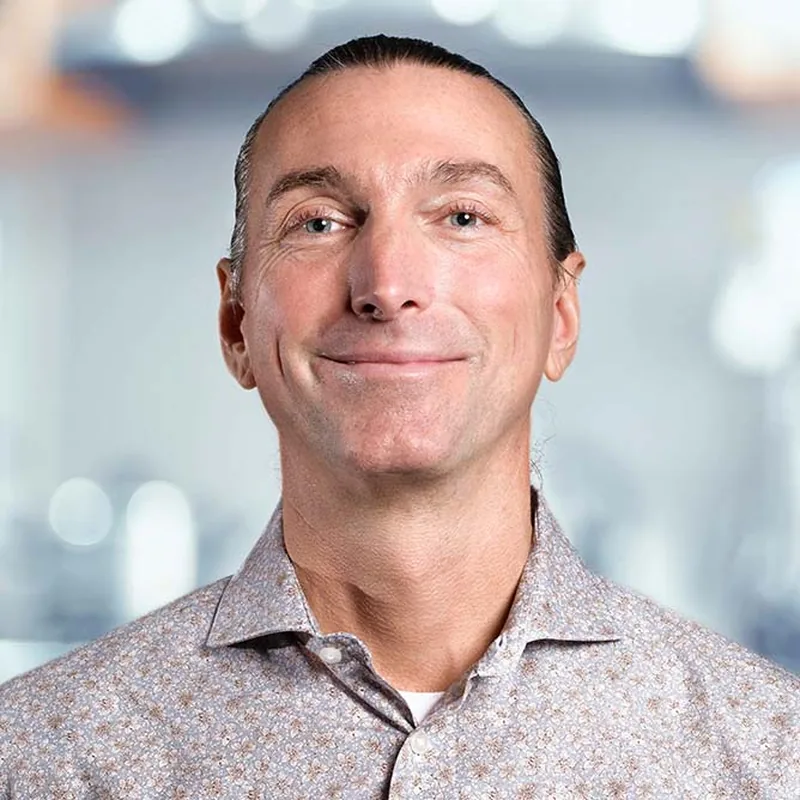
This is the same pattern Dr. Todd J. Pesek, M.D. — a board-certified family medicine physician with 20+ years of practice in Ohio (affiliated with Cleveland Clinic and Ashtabula County Medical Center) and a fourth-generation Appalachian root doctor — kept seeing on his own patients' bloodwork. High performers, "healthy" on paper, all showing the same signature: elevated cortisol, taxed adrenals, and a nervous system running on borrowed money.
What struck him wasn't the diagnosis. It was who kept showing up with it. Not the sedentary, not the burned-out — the sharpest operators in his practice. People whose calendars looked like proof of discipline, whose bloodwork looked like a slow-motion crash.
None of the standard fixes fit. Telling a founder to "drink less coffee" doesn't solve the underlying reason they reach for it. And every product on the shelf marketed at these patients was just another stimulant with better branding. So he started formulating something different — not to replace the coffee, but to give the brain something real to run on underneath it.
For readers who want to go deeper, see Dr. Pesek's clinical research background.
Not All Focus Supplements Are Created Equal
Walk any supplement aisle and you'll see it: dozens of "focus" and "nootropic" products, most of them caffeine or a synthetic stimulant in a new package. Rebranded pre-workout, essentially. They deliver the same spike, the same crash, and the same long-term cost we've been talking about — just with a cleaner label.
The category that actually matters — neuron support, not neuron stimulation — is small. The ingredients are harder to source, harder to extract correctly, and much harder to dose at clinical levels without cutting corners. Which is why most brands don't bother.
The Formula Dr. Pesek Built
What he formulated is Nutritional Roots Lion's Mane + Resveratrol — a two- ingredient stack built specifically for the pattern above, with no stimulants, no fillers, and nothing that spikes the nervous system.
- 800mg Lion's Mane — dual water/alcohol extraction, so you get both the water-soluble beta-glucans and the fat-soluble hericenones. Most brands only extract one.
- 350mg Trans-Resveratrol — sourced from Appalachian Kudzu, not the cheaper red-wine extract most supplements use.
The framing Dr. Pesek uses is "now and later." Lion's Mane gives you brain clarity today — the sustained, non-jittery kind. Trans-Resveratrol works on the longer arc: protecting neurons and cardiovascular tissue over years, not hours. One bottle, two timelines.
This Formula vs. Typical Stimulant Nootropics
Lion's Mane + Resveratrol
Energy curve
Sustained clarity, no crash
Mechanism
Supports neurons directly (NGF pathway)
Formulation
Doctor-formulated, clinical doses
Testing
Third-party tested, ISO-certified lab
Long-term effect
Supports brain & heart over time
Typical Stimulant Nootropics
Energy curve
Spike, then crash in 3-4 hours
Mechanism
Synthetic stimulants force adrenaline release
Formulation
Marketing-led, under-dosed blends
Testing
Untested claims, proprietary blends
Long-term effect
Depletes the system it's stimulating
| Lion's Mane + Resveratrol | Typical Stimulant Nootropics | |
|---|---|---|
| Energy curve | Sustained clarity, no crash | Spike, then crash in 3-4 hours |
| Mechanism | Supports neurons directly (NGF pathway) | Synthetic stimulants force adrenaline release |
| Formulation | Doctor-formulated, clinical doses | Marketing-led, under-dosed blends |
| Testing | Third-party tested, ISO-certified lab | Untested claims, proprietary blends |
| Long-term effect | Supports brain & heart over time | Depletes the system it's stimulating |


